
Casino Masculinity: How Boys and Young Men Are Being Set Up to Lose

Photo by Krišjānis Kazaks

This post expands on an op-ed recently published in the Toronto Star by Next Gen Men Executive Director Jake Stika. The op-ed introduced the term ‘casino masculinity’ and called for action on Bill S-211, which would restrict gambling advertising in Canada. The response was significant—so we wanted to go deeper.
Picture a group chat during the Super Bowl or a full day of basketball during March Madness. By halftime or midday it’s full of odds, picks, and someone chasing losses from last week. Nobody calls it gambling. They call it watching the game.
This is how it starts—not at a casino, not at a card table. It starts in group chats, fantasy leagues, and phone screens. And according to new research, it already reaches boys as young as 11.
What Is Casino Masculinity?
‘Casino masculinity’ is a term for the way gambling has become wrapped up in what it means to be a man.
It shows up in sports culture, where betting on games is treated as normal—even expected—fan behaviour. It shows up in video games, where buying loot boxes and trading skins teaches boys early that spending money on chance is just part of playing. It shows up in influencer culture, where young men promote crypto and betting apps as shortcuts to wealth. And it shows up in the broader message boys receive: that real men take big swings, that risk equals strength, and that asking for help when you’re losing means you’re weak.
But casino masculinity isn’t only about gambling in the legal sense. The same logic runs through crypto culture, meme stock communities, pyramid‑scheme ‘financial freedom’ platforms, and the emerging world of prediction markets. The hook is identical to gambling: insider knowledge, the thrill of being in on something, and a masculine identity built around the willingness to take risks. What they all share is that the house wins, the boy loses more often than not, and the loss is framed to feel like his fault for not being bold enough.
And the ecosystem keeps expanding. Prediction markets—platforms like Kalshi and Polymarket, where users bet real money on the outcome of elections, sports games, and world events—are the newest front. The industry argues these aren’t gambling sites but ‘event contracts’—a way to turn your knowledge into a financial position. Critics, including federal financial regulators, call that a rebranding of sports betting. The practical effect is the same: a product that makes wagering feel like being smart, available on your phone, designed to keep you checking. Youth-specific research on prediction markets is still catching up to the platforms themselves—which is exactly what makes this moment worth paying attention to.
Teen Boys and Gambling: What the Research Shows
In 2026, Common Sense Media surveyed 1,017 boys between the ages of 11 and 17 across the United States. What they found should change the conversation.
More than a third of boys—36%—reported gambling in the past year. That number rises to nearly half by age 17. It starts at 32% among 11-year-olds.
Read that again: nearly one in three 11-year-old boys is already gambling.
The most common entry point isn’t sports betting. It’s video games. Nearly two thirds of boys who gamble (64%) are doing so through online gaming—loot boxes, skin cases, and random reward systems that are designed to feel like playing but work like slot machines. Gaming companies have spent years perfecting these mechanics. They know exactly what they’re doing.
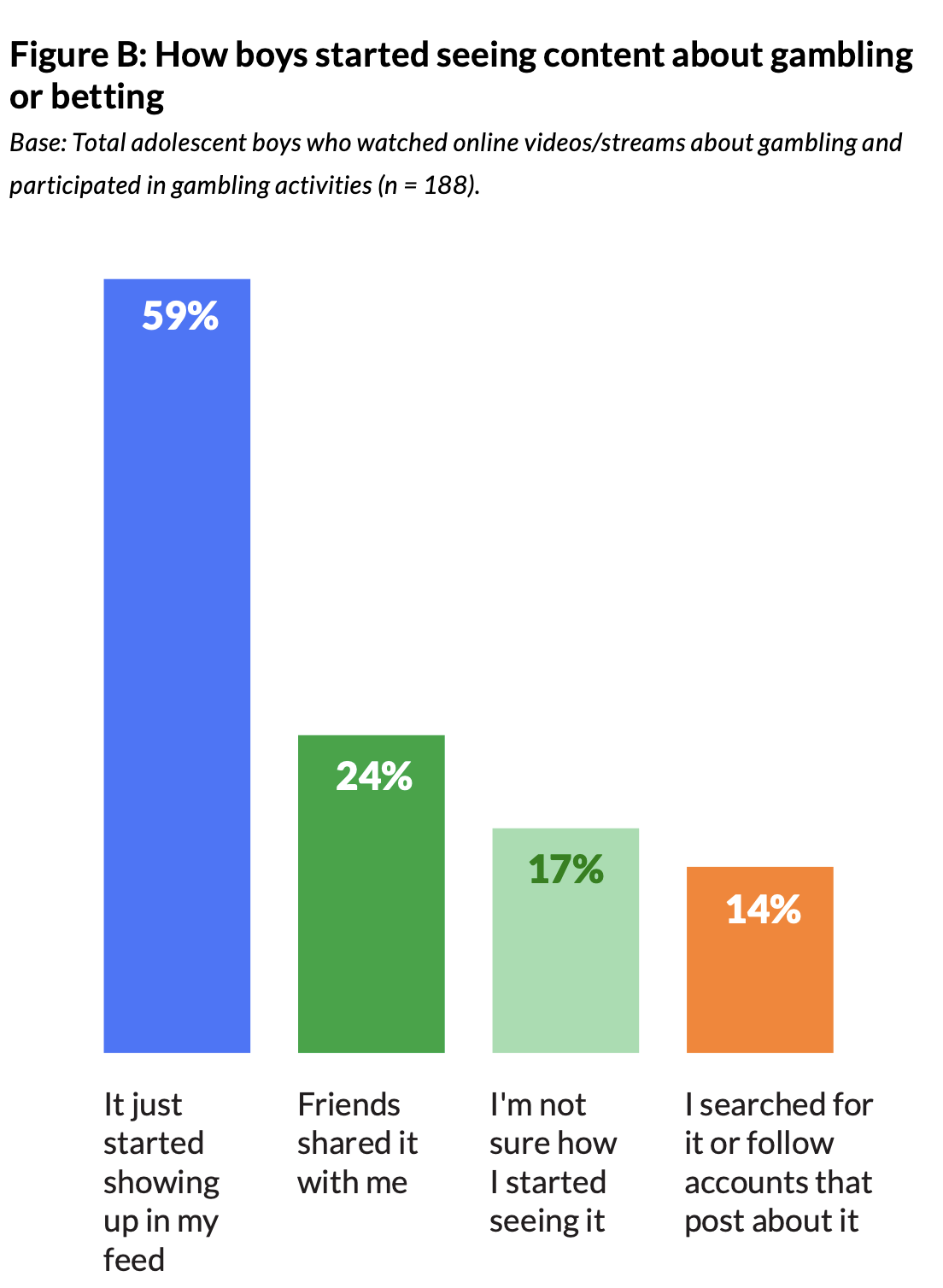
And then there’s what happens when the feed takes over. Nearly half of boys who gamble (45%) say they’ve seen gambling content online—but most of them didn’t go looking for it. 59% say gambling content “just started showing up” in their feed. Algorithms are doing the recruiting.
Boys who watch gambling content online spend more than twice as much on gambling as boys who don't ($72 vs. $33 per year). They're also far more likely to overspend—28% report spending more than they planned, compared to just 5% of non-viewers.
Sports betting isn’t the only door boys are walking through. A 2025 study of cryptocurrency traders found that nearly one in three showed signs of problem gambling—the same patterns of obsessive monitoring, chasing losses, and borrowing money to stay in. Researchers found enough overlap between crypto traders and problem gamblers that some are now calling for crypto use to be screened in gambling addiction treatment.
Why Boys and Young Men Are the Target
Since the U.S. Supreme Court opened the door to legalized sports betting in 2018, the gambling industry has exploded. By 2024, Americans were wagering roughly $148 billion on sports annually—a 30-fold increase from 2017. Today, 94% of bets are placed on a phone.
The American Institute for Boys and Men has documented what this means for young men specifically. Among men ages 18 to 49, nearly half (48%) now have an active online sports betting account. Two thirds of college-aged men (18–22) bet in the past year. And young men under 30 are now the group most likely to say that legal sports betting is bad for society—with that number rising from 22% to 47% in just three years. They’ve seen what it does.
In Canada, the picture is just as concerning. Gambling-related calls to Ontario’s provincial addiction treatment hotline increased 161% among males between 15 and 24 between 2022 and 2025. Men 18 to 29 are six times more likely to meet the criteria for problem gambling compared to older adults. Nearly one in three boys gambles to win money, not for fun. Close to 40% of young men who gamble wish they’d never started.
This isn’t happening the same way to girls. Girls gamble at significantly lower rates, are far less likely to develop problem gambling, and are not the target demographic for sports betting apps, crypto influencers, or loot box economies. That gap isn’t a coincidence—it’s the product. These industries have studied what masculinity asks of boys and built their marketing directly around it: the pressure to take risks, to have an edge, to not be the guy who sits it out. Casino masculinity isn’t just a metaphor. It’s a business strategy.
And the consequences don’t stop at money. Boys who gamble frequently miss more classes, perform worse in school, and drink more alcohol – often using other risky behaviours to cope with gambling-related stress. A long-term study tracking young men in Australia found that sports gambling specifically—not casino games, not lotteries, not poker—was the strongest predictor of future problem gambling in young men aged 18 to 25. When a boy gets hooked on sports betting, the research suggests it sets off a chain reaction that other forms of gambling simply don’t.
How the Industry Gets Boys Hooked
What makes casino masculinity so effective is that it doesn’t look like a trap. It looks like friendship. It looks like fandom. It looks like knowing your stuff.
Research on what boys actually need to thrive points to four things: belonging, independence, mastery, and purpose. Casino masculinity offers a counterfeit version of three of them—and uses that to get in the door.
-
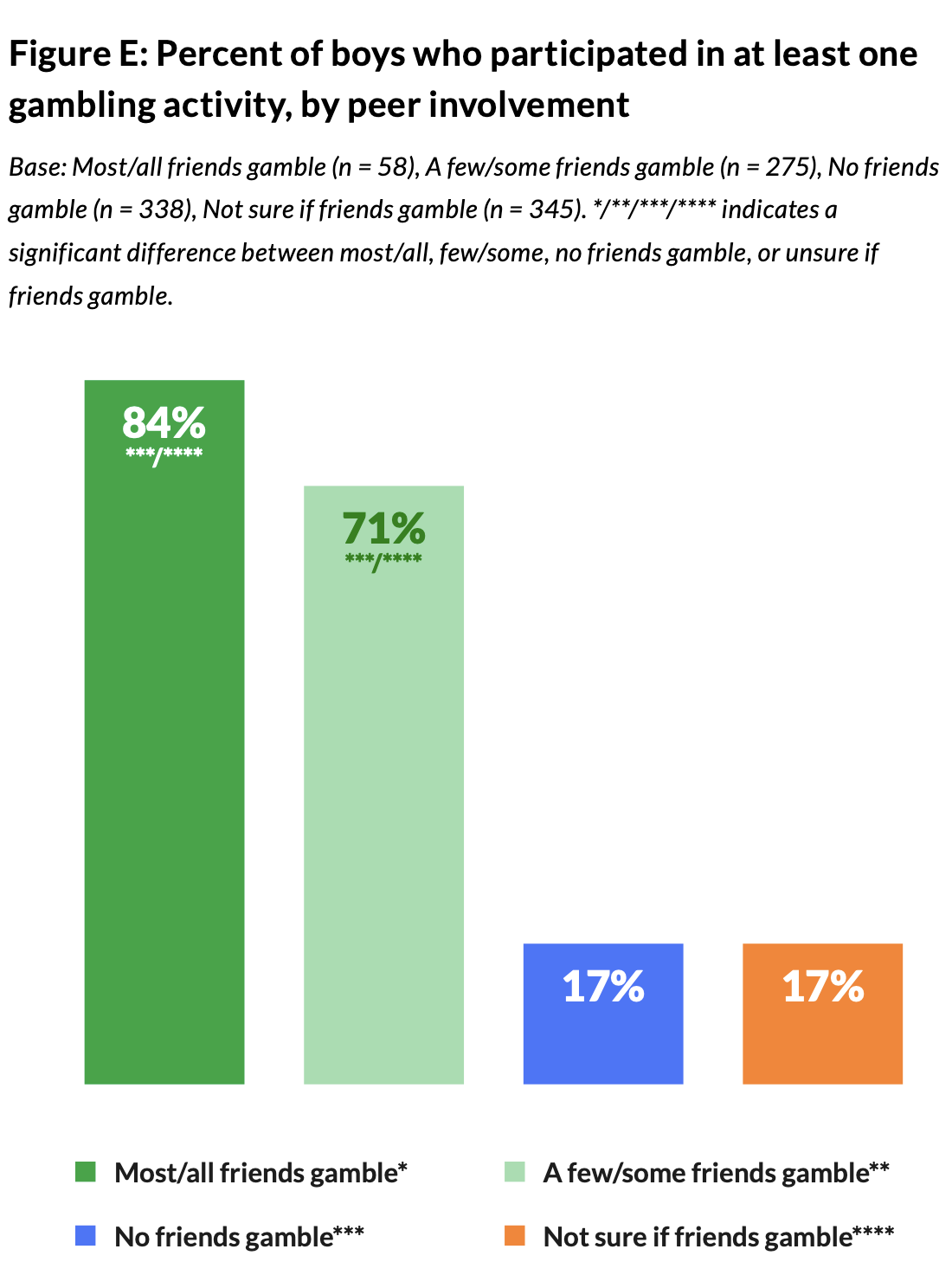
Common Sense Media found that peer influence may be the single biggest driver of adolescent gambling. Boys whose friends mostly gamble show 84% participation rates, compared to just 17% of boys with no gambling friends. Gambling becomes social currency—a way to be part of the group, have something to talk about, prove you know the game. The belonging feels real. The community is real. That’s what makes it work.
-
Boys thrive when they develop real skills and feel genuine pride in what they can do. Betting apps, crypto influencers, and schemes sell a shortcut to that feeling: the guy who sees what others miss, who takes the calculated risk, who doesn’t flinch. The person who bought Bitcoin before everyone else and never lets you forget it. The buddy who held GameStop stock to zero but framed it as an act of defiance—a warrior move, not a loss. The dude in the Discord server where everyone shares their portfolio like they’re sharing sports picks, where admitting a loss is social suicide. It’s a counterfeit version of mastery—and for boys still figuring out who they are, it can feel like the real thing, because the insider knowledge and the thrill of being in on something aren’t incidental.
-
Boys and young men have a deep need to feel capable—to stand on their own two feet, make real choices, and see that those choices matter. The problem is that at 15, 18, or 21, you genuinely haven’t had time to build much yet. That’s not a character flaw. That’s just where you are in the timeline of life. The gambling industry, and the broader ecosystem around it, exploits that gap deliberately. The influencer flexing wealth at 22 isn’t accidental content—it’s a targeted message to boys at exactly the moment they’re most hungry to prove something and least equipped to see the grift. You could have this. Right now. From your phone. It bypasses the years of work the traditional path requires and sells the feeling of independence without any of the substance underneath it.
-
Boys and young men need to feel like their lives point toward something beyond themselves—that they matter to other people, that they're building something real. Casino masculinity has no answer for this. Every metric it offers is personal: your picks, your portfolio, your wins, your losses. A boy can be deep in a betting Discord, surrounded by hundreds of people, and still be entirely alone—because the community exists to validate him, not to build anything together. When that emptiness doesn’t go away, the platform’s solution is always the same: more bets, more trades, more product. The unmet need gets fed back into the machine that created it.
The AIBM research is clear on who benefits from all of this—and it isn’t boys. Bankruptcy rates rose 28% in states after online sports betting was legalized. Every dollar spent on sports betting reduced investment savings by 99 cents. A Wall Street Journal review of one major U.S. sportsbook found that 0.5% of the customer base generated more than 70% of the company's revenue. Rather than selling entertainment, the industry is extracting money from a small group of heavy losers—and young men are being set up to be those losers.
When the losses mount, the toll isn’t just financial. The director of Massachusetts General Hospital’s Digital Addiction and Gambling Treatment Program says that when young people are significantly in debt from gambling, they feel trapped and helpless and feel like there’s no way out. That’s less a gambling problem and more a pipeline to a mental health crisis.
Warning Signs Your Son May Have a Gambling Problem
The boys who end up in trouble don’t look that different from the ones who don’t—at first. But Common Sense Media’s data shows a clear pattern of how casual gambling becomes something harder to walk away from.
Among boys who lost $51 or more gambling in the past year, nearly three quarters watch gambling content online regularly—double the rate of boys with smaller losses. Half of them spent more than they planned to. One in five used a parent’s debit or credit card without permission. A third say they gamble because their friends do, and nearly one in five points to a social media influencer as a reason they started.
These aren’t the behaviours of boys who stumbled into something harmless accidentally. They’re the profile of boys being actively recruited, socially reinforced, and financially drained, often without the adults in their lives knowing it’s happening.
And the boys themselves often know something is off. Nearly 40% of boys who gamble report wishing they hadn’t. 27% say gambling has caused them real problems—stress, conflict with parents, or consequences they didn’t see coming.
How to Talk to Boys About Gambling and Crypto
The instinct, when we see these numbers, is to tell boys gambling is bad. To say ‘just don’t.’
That doesn’t work. Telling boys something is dangerous rarely stops them—especially when everyone around them is doing it and nobody seems to have been hurt. What actually shifts things is transparency about who profits.
When boys understand that the house doesn’t just win by the odds—it’s designed to win—the appeal starts to look different. When they see that the influencer posting about his big win is paid by the betting company, that the ‘risk-free bet’ is engineered to hook them, that 70% of one major sportsbook's revenue comes from just 0.5% of its customers—they’re not just making a free choice anymore. They’re seeing the game behind the game.
The same question applies to every version of casino masculinity. Asking who actually made money tends to cut through the noise faster than any warning label.
This doesn’t have to be a lecture. Ask a boy what he thinks the odds on a parlay—a multi-game bet where you need to win every pick—actually are, then do the math together. Ask him how a loot box is different from a slot machine, and listen to what he says. Ask who gets rich when someone loses a bet. These conversations don’t require a curriculum. They require curiosity and enough trust that he doesn’t feel like he’s being caught doing something wrong.
What Parents, Educators, and Policymakers Can Do
Individual conversations matter. But individual conversations didn’t create casino masculinity, and they can’t end it alone.
Start with the advertising. 61% of boys ages 11–17 have seen gambling ads on YouTube. 60% on social media. 57% during live sports. The industry saturates the spaces boys already occupy and normalizes betting as part of being a fan, a gamer, a guy who knows things. Canada’s Bill S-211 would restrict that advertising, and U.S. proposals like the SAFE Bet Act would ban sportsbooks from using AI to target users who just lost money. These are the kinds of guardrails that don’t just ask boys to opt out of a culture but actually challenge the culture itself.
Gaming platforms and social media need accountability. Loot boxes and randomized reward systems represent slot machine mechanics deliberately embedded in games rated for children as young as 10. The industry knows this. These systems were designed by the same behavioural scientists who optimize casino floors, and they generate billions in revenue from players who, in many cases, aren’t old enough to legally gamble anywhere. A boy doesn’t need a betting account to develop a gambling problem. He just needs a game that charges him for a chance at something he wants. Regulators have been slow to call this what it is. That slowness has a cost, and children are paying it.
Then there’s the algorithm problem. If we know that most boys who see gambling content online didn’t actively look for it, then we know that social media companies need to stop algorithmically promoting gambling content to users under 18.
Schools have a role here too. Most boys will spend years sitting through probability and expected value lessons without ever understanding why it matters. The answer is sitting on their phone. A parlay bet where you need to win four picks in a row gives you roughly a 6% chance of winning. A loot box with a 1% chance at the rare item means you’d need to open about 70 boxes just for a coin-flip shot at getting it. Teachers don’t need a new course to make this land, they just need permission to point at the thing boys are already looking at. The same goes for digital literacy and health: recognizing manipulative design, understanding how platforms profit from risky behaviour—these are life skills boys are navigating right now, whether schools engage with them or not.


Photo by Nick Jones
The Bet Worth Making
At the heart of casino masculinity is a lie about what it means to be a man.
Let's be clear about something first. The frustration driving boys toward these shortcuts isn’t irrational. Wealth is more concentrated than it’s been in generations. Upward mobility has stalled. Young people are inheriting an economy that wasn’t designed with them in mind, and they know it. That anger is legitimate, and it deserves to be taken seriously, not dismissed.
What isn’t legitimate is how that frustration is being monetized. Gambling developers and influencers have looked at a generation of young men who feel locked out and said: We can profit from that. Every dollar a struggling 19-year-old loses on a bet is a dollar that flows upward, toward the same concentrated wealth that made him feel locked out in the first place.
Regulatory bodies have been slow to respond. Legislation like Canada's Bill S-211 and U.S. proposals to restrict gambling advertising are steps in the right direction—but policy moves slowly and industries move fast. In the meantime, the one place we have real leverage is culture. We can change what gets normalized in friend groups, in locker rooms, in classrooms. We can make it easier for boys to name the grift than to fall for it. We can build a culture where a boy’s worth isn't measured by the size of his bet, or his portfolio, or his risk tolerance, or any other proxy the market uses to define masculine success.
The boys and young men who are most at risk aren’t reckless. They’re looking for belonging, for a feeling of control, for a way to prove themselves in a world that keeps telling them the rules don’t apply. They deserve honest answers to real problems. Not a betting app that profits from their pain.
That’s the bet worth making.